
 Written by
 Before discussing the bracelet code at straw events among colleagues, let's talk about the handkerchief code for a better understanding of its use.
Handkerchief Code
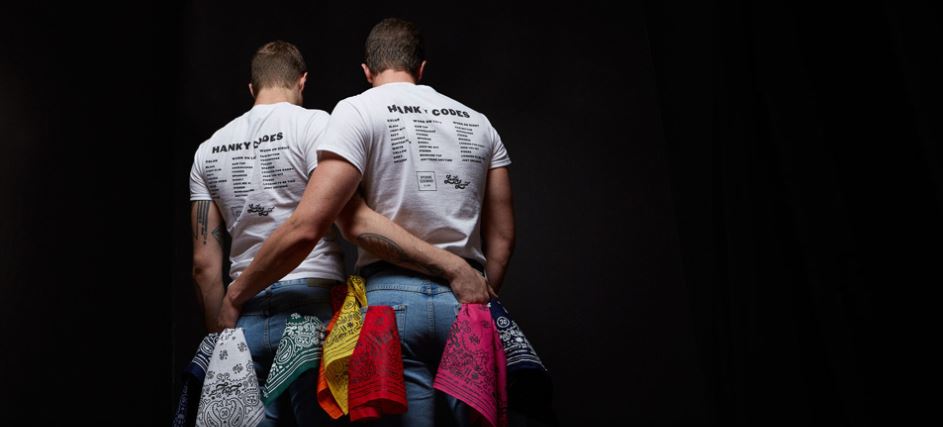
The handkerchief code (translated from English as handkerchief code and also known as hanky code or flagging) is a means of non-verbal communication used in different social and political contexts, so the interpretation of a type of handkerchief depends on its color, pattern, and the body part where a person wears it.
Currently, its uses are mostly aesthetic and are widely used in the fashion world, but they encompass a wide range of utilities and meanings beyond being mere accessories; it always depends on people taking certain colors as symbolic of a movement in a specific era.
Origins
One widely used type of handkerchief over time is the Paisley bandana and its characteristic patterns called "cashmere," whose origins date back to ancient Persia and represent the natural forms of flower and tree dew, such as the cypress, in symbolism of life and eternity of the Zoroastrian religion, typical of the Persians from the 6th century BC.
Until Western societies began to adopt them, in Asian or Hindu regions they also symbolized fertility and a set of ideologies that ended up being lost when they were treated as accessories in Europe in the early 18th century and spread through various English and later American subcultures.
Handkerchiefs and Cowboys
Cowboys were hired riders (or more commonly cowboys) responsible for herding cattle. The popular culture and cinema of the 1930s popularized the figure of these riders and often stereotyped their attire, including the bandanas they used for horseback rides and to protect themselves from dust or sand in the arid areas of Mexico and the United States.
Wearing colored bandanas around the neck was common in the mid to late 19th century among cowboys, railroad engineers, and miners in the western United States, who also used them for ideological or utilitarian reasons.

Handkerchiefs and Rock and Political Culture
Handkerchiefs spread among rock communities in the 1950s and 1960s, so rock culture was for many years the main reason for using these accessories, in addition to being the predominant genre for decades in the music scene, its styles and combinations when worn on the head, wrist, or clothing spread to subcultures and street bands, for example, among bikers or revolutionaries. Over time, colors have been popularly politicized with certain movements, so depending on the country, the color of the handkerchief, and the context in which it is used, it can indicate the ideological position of the person wearing it.
Handkerchief Code in the LGBT+ Community
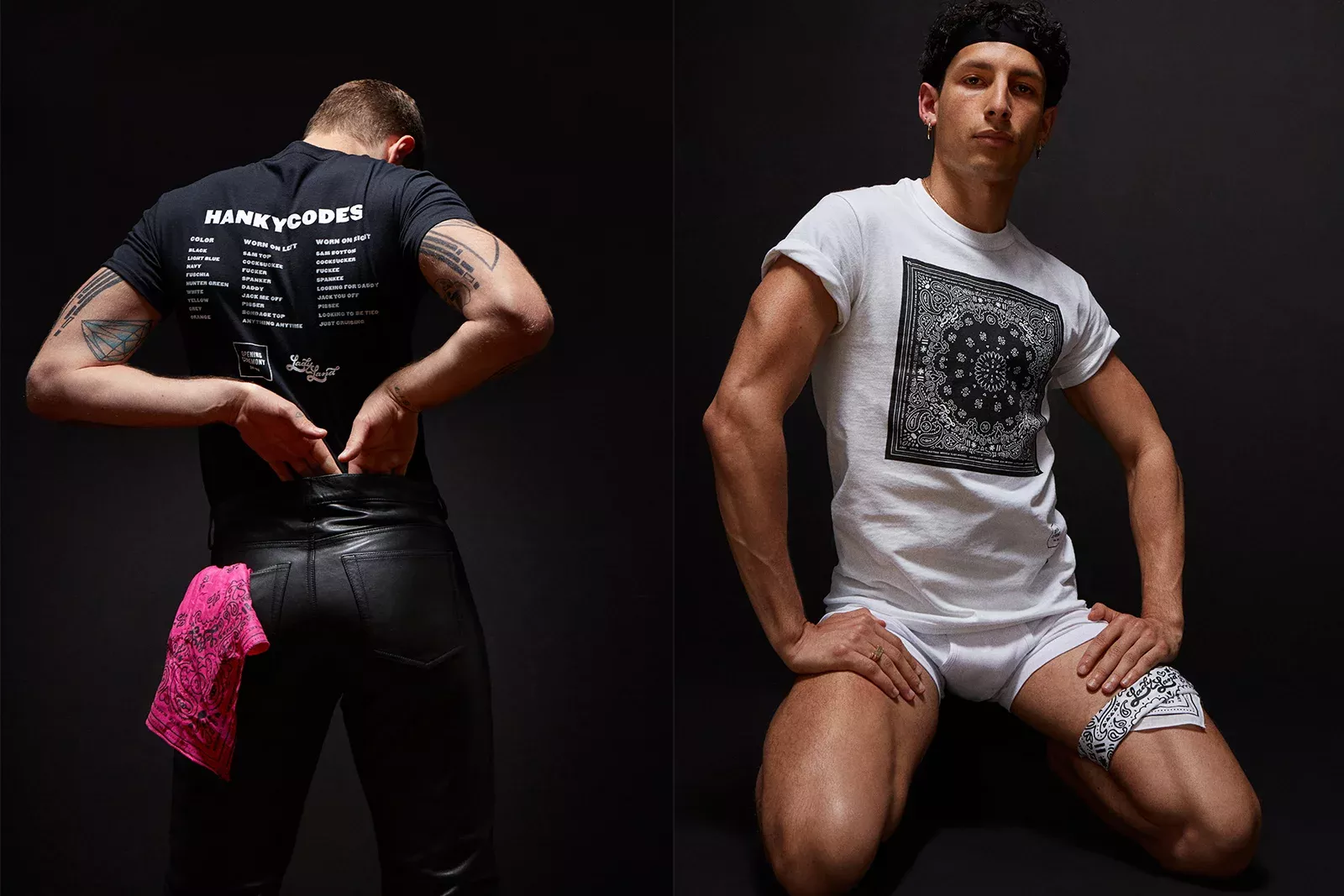
In the gay scene, generally in places where casual sex is sought or in leather culture venues where BDSM is practiced, to indicate the sexual practice of interest, preferred sexual fetishes, and whether one is active or passive. The use of the handkerchief code became widespread among American gay and bisexual men in the early 1970s, and later in the rest of the Western world.
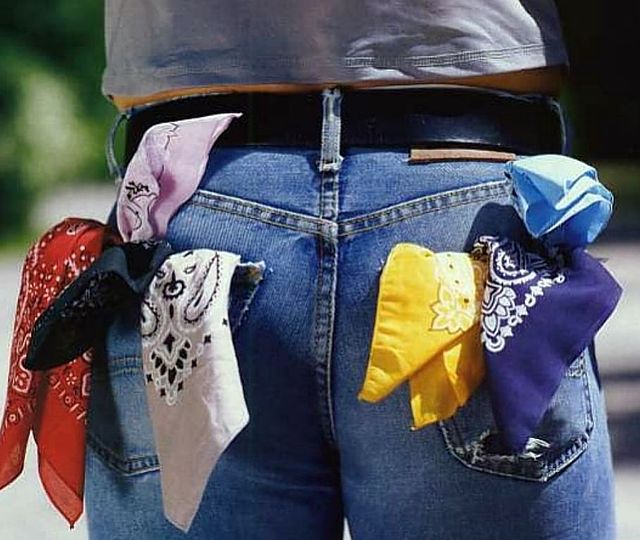
 This color code consists of wearing a colored handkerchief, usually hanging from the back pockets of pants, tied to belt loops, or around the arm. The handkerchief on the left side indicates being active —or the one performing the action indicated by the color of the handkerchief— and on the right, passive —or the one receiving the action indicated by the color of the handkerchief—. This left/right polarity originated in the use of a keychain on the left loop by the actives and on the right by the passives belonging to the leather culture. Handkerchiefs can also be worn tied around the neck —indicating being versatile, meaning that one both performs and receives the action indicated by the color of the handkerchief—, with the knot on the left or right, on the ankle, or in other parts of the body. In addition to handkerchiefs, the code can also be indicated with leather bracelets and plastic wristbands of the same colors.
Although there is a general consensus on the meaning of basic colors (yellow for urolagnia, white for masturbation, brown for coprophilia, and black for sadomasochism), there are multiple extended color lists, so the meaning of some colors may vary regionally.
Colors
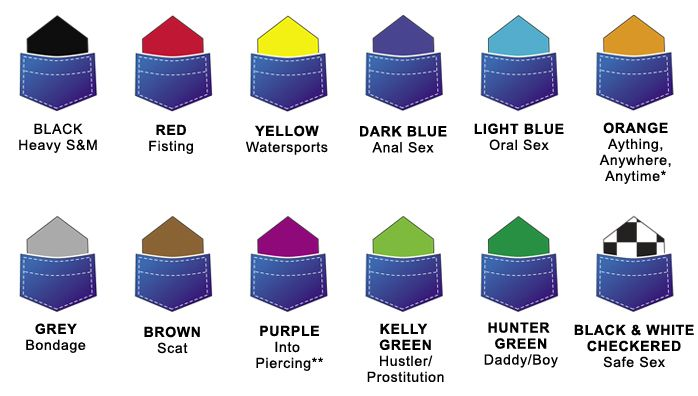
The basic and most widespread list consists of eleven colors. The left/right polarity is implicit in all the colors on the list: placing the handkerchief on the left indicates a desire to be the active or dominant member of the couple or the one performing the action, while on the right indicates a desire to be the passive or submissive member of the couple or the one receiving the action, according to each color —however, this can be ambiguous in some cases: for example, the light blue handkerchief on the left indicates a desire for oral sex, and on the right, performing oral sex
| Color | Meaning |
|---|---|
 |
Golden showers |
 |
Oral sex |
 |
Anal sex |
 |
Masturbation |
 |
Bondage |
 |
Scat |
 |
People with piercings |
 |
Any practice |
 |
S&M |
 |
Fisting |
 |
Prostitute |
In addition to handkerchiefs, leather bracelets or plastic wristbands in the same code colors can also be used.
Bracelet Codes at PeC Events
Understanding these colors, let's move on to identifying the bracelets at Straw Between Colleagues Events.
Level 1 / Level 2 Events
| Color | Meaning |
|---|---|
| Yellow | Do not touch |
| White | You can cum on me |
| Green | Any practice |
Level 3 Events
| Color | Meaning |
|---|---|
| Yellow | Active |
| White | Versatile |
| Green | Passive |